Light and Human Health #4 – When We Lost the Light: The Industrial Revolution and Health
The Industrial Revolution was the moment when entire societies were, for the first time in history, cut off from natural light. Cities, factories, smog, and work in enclosed spaces radically changed humanity’s daily relationship with the sun.
It was then that diseases linked to the lack of light and disruption of the natural rhythm of life began to emerge. The absence of sunlight affected public health and became a starting point for the birth of modern medicine.
Article from the series “Light and Human Health” – Part 4
For thousands of years, humans lived in rhythm with day and night. They worked in daylight, rested at dusk, and slept in darkness. Health, biological rhythms, and everyday functioning were inseparably connected to the movement of the sun. Even as cities, temples, and palaces developed, most of life still unfolded outdoors, in natural light.
This order was disrupted relatively recently.
The Industrial Revolution, spanning from the late 18th to the 19th century, marked the first moment in history when entire populations were physically and biologically cut off from sunlight. As noted by Carsten Carlberg, a scientist in vitamin D biology:
“During the Industrial Revolution, about 250 years ago, the real vitamin D problem began.”
It was then that a process started which permanently changed the relationship between humans, light, health, and the living environment.
Cities Without Sunlight: Industrial-Era Architecture
Rapid industrialisation triggered mass migration from rural areas into cities. London, Manchester, Birmingham, Glasgow, and other industrial centres expanded faster than infrastructure and urban planning could accommodate.
The new architecture of working-class cities was characterised by:
- narrow streets that almost completely blocked access to daylight,
- overcrowded tenement housing with minimal windows,
- dampness, poor ventilation, and permanent twilight,
- factory halls where people worked 12–16 hours a day under artificial lighting.
For many, contact with the sun was reduced to brief moments at dawn or after sunset. The natural rhythm of the day effectively disappeared.
Smog: A Wall Between the City and the Sky
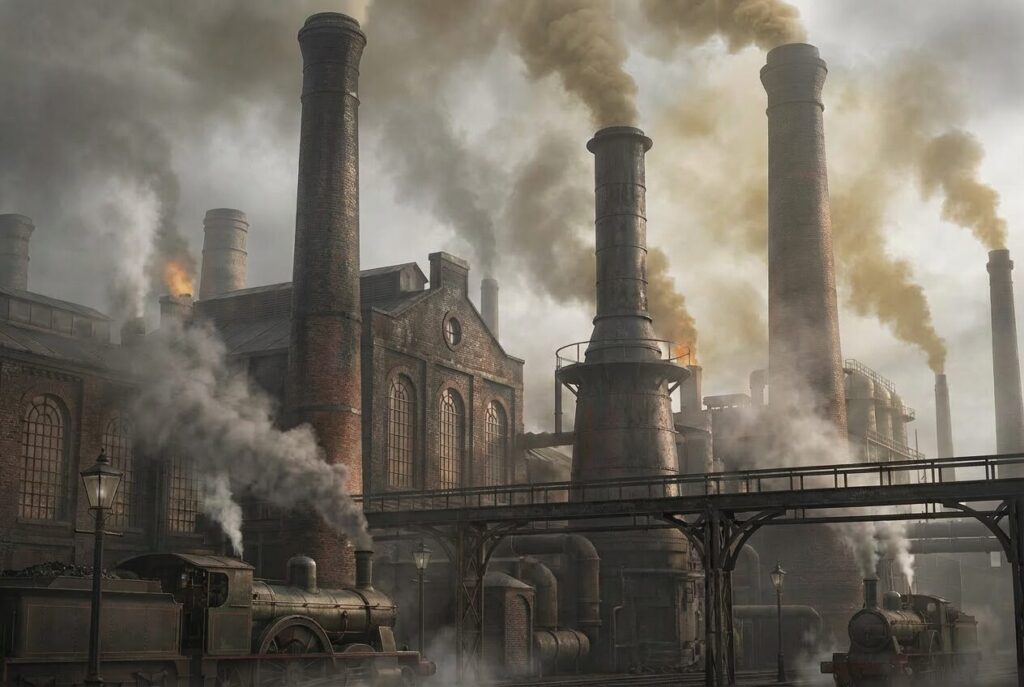
To the architecture of shadow, another factor was added: air pollution. The mass burning of coal created a phenomenon that 19th-century sources described as a “perpetual twilight.”
In industrial cities, smog was so dense that:
- sunlight rarely reached the streets,
- UV radiation was almost completely blocked,
- even at midday, the city remained in semi-darkness.
The term “pea-soup fog” emerged, describing a haze as thick as soup. In practical terms, this meant that even people spending time outdoors were not receiving biologically meaningful sunlight.
The Birth of the Diseases of Darkness
The consequences of this lifestyle shift appeared quickly and on a massive scale.
Rickets
For the first time in European history, entire populations of children with bone deformities were observed. Rickets became a distinctly urban disease, linked to the lack of sunlight, fresh air, and adequate living conditions. In some working-class districts, symptoms of rickets were present in the majority of children.
Tuberculosis
Damp, dark housing conditions promoted the spread of tuberculosis. Physicians observed that patients often improved after leaving the city, travelling to the mountains or the seaside, places with more light and fresh air.
Exhaustion and Mood Disorders
Historical sources from the period describe apathy, chronic fatigue, insomnia, and weakened immunity. Today, we would recognise these symptoms as circadian rhythm disruption and light deficiency. At the time, they were poorly understood and difficult to treat.
Early Attempts to Restore Health Through Light
Although the biological mechanisms of light were not yet known, physicians intuitively returned to long-standing recommendations: walking in daylight, travelling “for health” outside the city, opening windows, and improving ventilation.
During this period, European health resorts began to develop, along with the first principles of health-oriented architecture. These efforts, however, were local and fragmented rather than systemic.
Industrial-Era Hospitals: Places Without Light
The conditions of industrial cities were reflected in hospitals. Before the mid-19th century, hospitals were overcrowded, poorly ventilated, dark, and conducive to the spread of infections.
Light was not considered a therapeutic element. Like fresh air and space, it remained largely outside the focus of medical practice.
And it was precisely in this world that a figure emerged who would change the course of history.
Light That Had Not Yet Been Named
Nineteenth-century physicians observed the effects of sunlight deprivation, but they did not yet understand its biological mechanisms. They did not know what vitamin D was, nor did they understand UVB radiation or cutaneous synthesis processes. And yet, their observations were remarkably accurate.
Rickets, bone deformities, and increased susceptibility to infections appeared on a mass scale only in the industrial cities. It was not until 1922 that science gave this deficiency a name: vitamin D. As Professor Carsten Carlberg emphasises, this marked the first time in history that vitamin D deficiency became a population-wide problem.
For hundreds of thousands of years of evolution, humans lived in the light. Modernity was the first era to strip them of this biological foundation.
Florence Nightingale and the Return of Light to Medicine
It was within the dark, overcrowded hospitals of the 19th century that Florence Nightingale emerged.
She did not yet know the concept of vitamin D, but she saw what ancient physicians had understood: the absence of light worsened patients’ conditions, while its presence supported recovery. In Notes on Nursing (1860), she wrote:
“Second only to their need of fresh air is their need of light… and it is not only light but direct sunlight they want.”
Nightingale was the first to reintroduce light into modern medicine, not as intuition or tradition, but as a foundational element of systematic healthcare. Opening windows, orienting buildings toward daylight, providing space, fresh air, and access to sunlight became the cornerstones of her reforms.
From that moment on, the history of light in medicine entered a new chapter.
What’s Next in the “Light and Human Health” Series?
In the next part, we will take a closer look at the work of Florence Nightingale: her observations, hospital reforms, and how her approach anticipated modern chronobiology by more than a century. The story of sunlight in medicine continues.

Learn more:
The Industrial Revolution and Public Health
Chadwick, E., Report on the Sanitary Condition of the Labouring Population of Great Britain (1842)
Wohl, A., Endangered Lives: Public Health in Victorian Britain (1983)
Air Pollution
Brimblecombe, P., The Big Smoke: A History of Air Pollution in London (1987)
Rickets, Light, and Vitamin D
Glisson, F., De Rachitide (1650)
McCollum, E. et al., Studies on Experimental Rickets, Journal of Biological Chemistry (1922)
Holick, M.F., Vitamin D Deficiency, New England Journal of Medicine (2007)
Florence Nightingale
Nightingale, F., Notes on Nursing (1860)
McDonald, L., Florence Nightingale’s Health in History (2017)
A Quote from Professor Carsten Carlberg
Transcript of Professor C. Carlberg’s lecture (Lecture: “Vitamin D Signalling Pathways In Vivo: The Impact of the Vitamin D Response Index on Health and Disease”) (2025) – 7th International Conference “Vitamin D – Minimum, Maximum, Optimum – EVIDAS 2025”, Warsaw
Discover More

Light and Human Health #3 – The Sun as the Clock of Life: Rhythm, Balance, and Health in Traditional Medicine
For millennia, the Sun has shaped the rhythm of life and health. In traditional medicine, it functioned as a natural “clock of life,” regulating activity, rest, and bodily balance. Today, science confirms that without light, neither our circadian rhythm nor mental well-being can function properly.

Light and Human Health #2 – Sun of the Ancients: Light in the Medicine of the Bronze Age, Greece & Rome
Long before science emerged, the sun taught people how to live in harmony with nature and became one of the first tools for supporting health. In this part of the “Sunlight in Medicine” series, we return to the Bronze Age and ancient Greece to see how light shaped the earliest healing practices.

Light and Human Health #1 – When Light Was Medicine: A Forgotten History
For millennia, sunlight supported healing and health. Today, science confirms what earlier generations knew: without light, neither our bodies nor our minds can function properly. We return to the forgotten history of Light in human health.