Light and Human Health #3 – The Sun as the Clock of Life: Rhythm, Balance, and Health in Traditional Medicine
For millennia, the Sun has structured human life and health, shaping the rhythm of day and night as well as the changing of the seasons. In traditional medical systems, light was not merely an element of nature, but a natural “clock of life”, a regulator of activity, rest, and the body’s balance.
Today, science increasingly confirms what once seemed intuitively obvious: that without light, our circadian rhythm, metabolism, and mental health cannot function properly. By returning to the perspective of traditional medicine, we rediscover a forgotten language of rhythm, time, and biological synchronisation.
In the third part of the “Light and Human Health” series, we explore how, in traditional medical systems, sunlight functioned as a natural regulator of life’s rhythm, health, and bodily balance, long before the advent of mechanical clocks and artificial lighting.
Introduction: Light as a Measure of Biological Time
Before humans learned to measure time using mechanical clocks, and later artificial lighting and rigid schedules, life was synchronised with the natural rhythm of day and night. Sunrise and sunset marked periods of activity and rest, while seasonal changes regulated patterns of work, nourishment, and regeneration.
In classical systems of traditional medicine, sunlight was not treated as a separate therapeutic intervention. Instead, it served as a fundamental point of reference for organising biological life and, consequently, health. In this sense, the Sun functioned as a clock of life – a natural regulator of physiological, psychological, and environmental rhythms.
Classical Chinese Medicine: the Rhythm of Yang and the Order of the Day
One of the most thoroughly documented systems of traditional medicine is Classical Chinese Medicine (TCM), whose theoretical foundations are described in the Huangdi Neijing (The Yellow Emperor’s Inner Canon). The earliest layers of this text date back to between the 4th and 1st centuries BCE and present health as a state of dynamic balance between two qualities: Yin and Yang.
Yang is associated with activity, warmth, movement, and the body’s protective function. In the Huangdi Neijing, Yang is often functionally compared to the Sun in the sky—a factor that enables life, growth, and the proper course of biological processes. When Yang is strong and synchronised with the rhythm of the day, the organism retains its ability to adapt to changing environmental conditions.
Daytime, as the period of light, was understood as a natural time for activity and expression, while night was seen as a time of regeneration and restoration. Disruption of this sequence—for example, through prolonged nighttime activity or separation from natural daylight—was regarded as a factor contributing to weakened health. Although Classical Chinese Medicine did not employ the concepts of modern chronobiology, its observations clearly point to the importance of regularity and alignment with the rhythm of light.
The Day-Night Rhythm as a Foundation of Health
In traditional Chinese thought, health was not a static condition but a continuous process of attuning the organism to the changing conditions of day and night. Sunlight functioned as a primary environmental signal, organising the activity of both body and mind.
Disruptions of this rhythm, such as excessive activity after dark, insufficient exposure to daylight, or living in opposition to natural periods of rest, were considered factors that disturbed balance. Health was understood as the ability to “follow the day,” rather than to impose an artificial rhythm upon the body.
Seasonality and Adaptation to Light
Beyond the daily rhythm, Classical Chinese Medicine placed great emphasis on seasonal variability. The seasons were understood as expressions of the cyclical movement of the Sun and changes in environmental quality to which the organism must continually adapt.
Winter required the conservation of resources and energy, spring called for a gradual activation of activity, summer encouraged openness and expansion, and autumn signalled a return to inward focus and regeneration. Health did not depend on maintaining an unchanging lifestyle throughout the year, but rather on the capacity to adapt to the rhythm of light and the seasons.

I Ching: Light as a Moment Within the Cycle
In classical Chinese thought, the rhythm of light was present not only in medicine but also in the philosophy of change and time. In the I Ching (The Book of Changes), the Sun does not appear as an astronomical object, but rather as a symbol of the Yang principle: brightness, activity, and daytime.
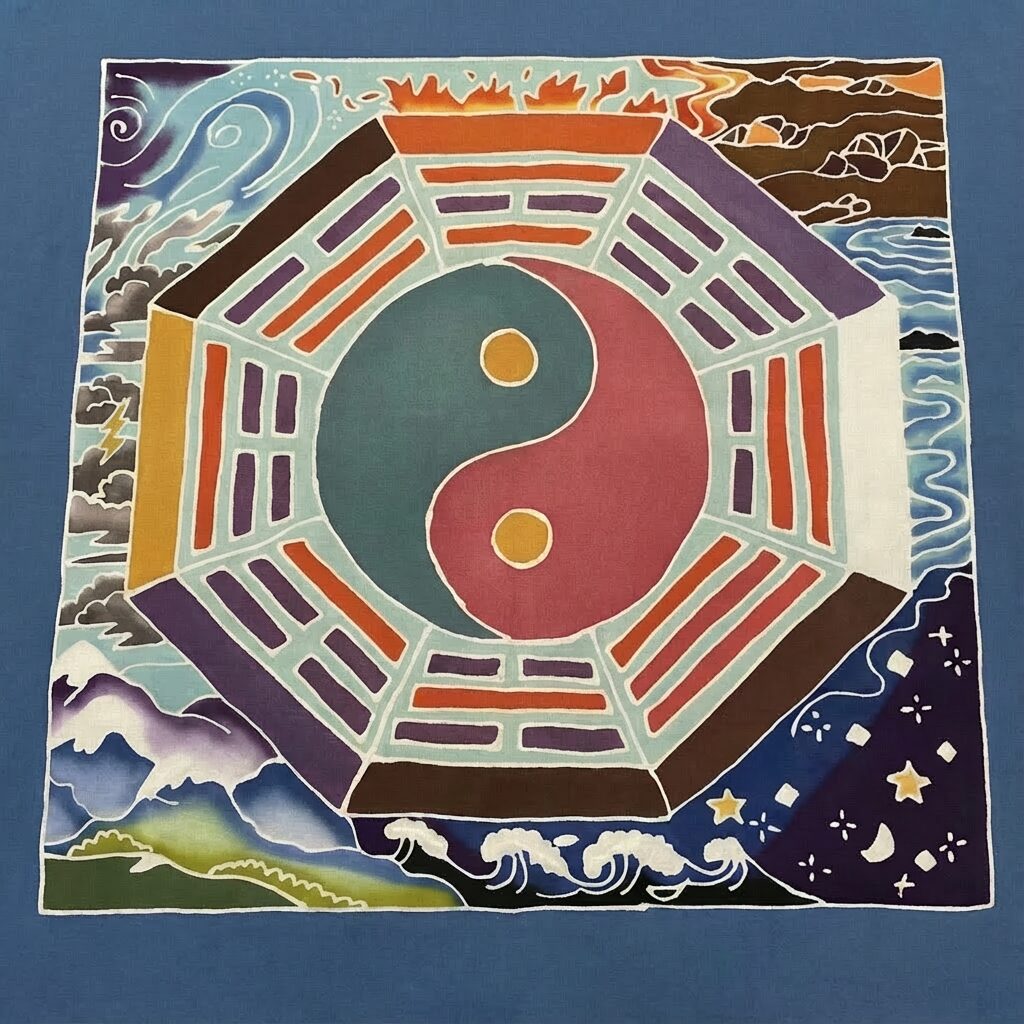
This is expressed most clearly through the trigram Li (☲), associated with fire and light, the time of noon, and the moment of peak daily energy. In this framework, the Sun does not “measure” time in a mechanical sense; instead, it reveals the appropriate moment within a cycle, indicating a phase of rhythm rather than an abstract hour. This cyclical understanding of time, grounded in the observation of light and its transformations, formed an important background for later conceptions of health as a process synchronised with nature.
Image: Bagua symbol incorporating the Yin-Yang sign and motifs of natural forces, from the Karuna Arts collection, author’s own photograph.
Ayurveda: the Rhythm of the Day and the Rhythm of the Year
A similar perspective can be found in Ayurveda, the classical system of Indian medicine whose primary aim was prevention and the maintenance of health through harmony with nature. Central to this approach are the concepts of Dinacharya (daily rhythm of life) and Ritucharya (seasonal rhythm).
Dinacharya describes how activity, rest, meals, and hygiene should be aligned with the daily cycle. Morning light marks the beginning of metabolic activity, supports alertness, and initiates physiological processes related to movement and digestion. Evening and night, by contrast, are understood as periods of gradual winding down and regeneration.
Ritucharya refers to seasonal changes and indicates that diet, intensity of activity, and patterns of rest should shift in accordance with the Sun’s movement across the sky. As in Classical Chinese Medicine, health was understood not as the result of isolated interventions, but as the alignment of lifestyle with the rhythm of the environment.
Health as Synchronisation, Not Intervention
In both Chinese medicine and Ayurveda, light was not treated as a therapeutic agent applied to specific disease entities. Instead, it was regarded as a constant element of the environment whose influence needed to be taken into account in everyday life.
Health was understood as the result of long-term synchronisation of the organism with natural cycles: day and night, the seasons, and variations in light and temperature. In this sense, the Sun functioned as a biological clock, not by imposing rigid rules, but by setting the framework within which healthy functioning could unfold.
The Significance of This Perspective in the History of Light-Based Medicine
An analysis of classical systems of traditional medicine shows that humanity’s relationship with light was, for millennia, continuous and self-evident. The Sun was perceived neither as a threat nor as a miraculous cure, but as a natural regulator of biological rhythm whose presence was integral to maintaining health.
Only with the development of artificial lighting, mechanical clocks, and the industrial organisation of time did everyday life gradually become detached from natural light cycles. This moment marks a critical turning point in the history of medicine and health, and it is precisely to this shift that the next part of our series will turn.
What comes next in the series?
In the next parts of our series, we will explore in more detail:
- Florence Nightingale, and the role of light in the birth of modern hospital medicine,
- Swiss heliotherapy sanatoria, their remarkable protocols and the famous “beds in the snow”,
- Niels Finsen, pioneer of scientific phototherapy and Nobel laureate,
- The Wolff brothers, the origins of modern sunbeds and their original health-focused intention,
- The decline of heliotherapy, why light disappeared from mainstream medicine after World War II,
- Modern photobiology, and how current science is rediscovering the influence of light on circadian rhythms, immunity, heart health, and mental well-being.
Worth Watching
A contemporary example of how the rhythm of the Sun continues to organise everyday life can be found in a film produced by UNESCO, dedicated to the traditional Chinese system of the 24 Solar Terms. Based on careful observation of the Sun’s annual movement and its shadow, the year is divided into 24 periods corresponding to climatic and environmental changes. To this day, the system regulates patterns of work, agriculture, festivals, and daily health-related practices, demonstrating that the Sun is not merely a relic of medical and cultural history, but remains a living regulator of time, life rhythms, and cultural practice.
Explore More

Light and Human Health #2 – Sun of the Ancients: Light in the Medicine of the Bronze Age, Greece & Rome
Long before science emerged, the sun taught people how to live in harmony with nature and became one of the first tools for supporting health. In this part of the “Sunlight in Medicine” series, we return to the Bronze Age and ancient Greece to see how light shaped the earliest healing practices.

Rethinking sunlight: What the latest science says about UV and health – A conversation with medical researcher Uwe Riedmann and the case for a new public approach
A conversation with Uwe Riedmann on a groundbreaking report on the health benefits of UV exposure and why current public health recommendations may need reconsideration, also discussed in the context of the latest ESA position paper.

The story of our skin #2 – Migration, lifestyle, and vitamin D
Skin color is the result of a brilliant survival strategy – for thousands of years, pigmentation adapted to the amount of sunlight in the environment.
Today, however, our lives look very different from the past – we spend most of our time indoors, with very little contact with natural sunlight…

Sunlight is more than Vitamin D: what sensible sun exposure really does for your health, based on insights by Dr. Michael Holick and analysis by Dr. Joseph Mercola
As Dr. Holick puts it: “We were designed by nature to be exposed to sunlight daily—not just for vitamin D, but for a whole range of processes that support our health and vitality.”