
Light and Human Health #6 – Sanatoria and Heliotherapy in the 19th and 20th Century: Treating with Light Before the Era of Antibiotics
Sanatoria of the 19th and 20th centuries were places where, for the first time in modern history, light began to be treated as an element of therapy. In the era before antibiotics, it was sunlight, fresh air, and carefully designed environmental conditions that formed the foundation of treatment for many diseases, including tuberculosis.
The history of heliotherapy shows that the relationship between humans and light has always been part of health. Looking back today, we can better understand the role light once played in medicine, before it was gradually replaced by pharmacology.
[Photo: Jullien, Frères Titel: Leysin, Sanatorium Populaire et le Pic de Chaussy Beschreibung: Poststempel 10.3.1913 Datierung: vor 10.3.1913 Fotograf: Jullien, Frères Titel: Leysin, Sanatorium Populaire et le Pic de Chaussy Beschreibung: Poststempel 10.3.1913 Datierung: vor 10.3.1913 Lizenz: Public Domain Mark]
Historical Context
In the 19th and early 20th centuries, medicine was in a very different place than it is today. Antibiotics did not yet exist, and many diseases, including tuberculosis, posed a serious threat to entire populations. In this world, light was not a luxury or a matter of comfort. It was one of the tools of treatment.
Sanatoria, which began to emerge across Europe and the United States, were based on a simple principle: the body needs the right conditions to restore balance. Fresh air, movement, a structured daily rhythm, and exposure to sunlight together formed a system that today we would describe as environmental therapy.
It was in these places that, for the first time in modern history, light began to be treated as a real component of the healing process.
The Rise of Sanatoria
One of the pioneers of this approach was the German physician Hermann Brehmer, who in 1854 founded the first modern tuberculosis sanatorium in Görbersdorf (now Sokołowsko, Poland).
Brehmer believed that tuberculosis was not merely a disease of the lungs, but a condition affecting the entire organism, one that had lost its capacity to defend itself. Treatment, therefore, should focus on gradually rebuilding the patient’s strength through carefully designed environmental conditions.
Three elements were considered essential:
- fresh air
- sunlight
- regular physical activity
Although the biological mechanisms of light were not yet understood, physicians were already beginning to observe its clear impact on patient health.
Hermann Brehmer’s Method: Light as Part of Stimulus-Based Therapy
In Brehmer’s sanatorium in Görbersdorf, sunlight was not treated as a single intervention, but as part of a broader concept of stimulus-based therapy.
He believed that the body could be strengthened through carefully calibrated environmental stimuli: light, air, temperature, and movement.
Controlled Exposure to Light
Patients received detailed guidance on how much time to spend outdoors. Physicians determined whether a patient should rest in full sunlight or in partial shade, and for how long.
Although the term heliotherapy would only emerge later, the practice of gradual, controlled exposure to light was already in place.
The “Open-Air Cure”: Resting in Light and Air
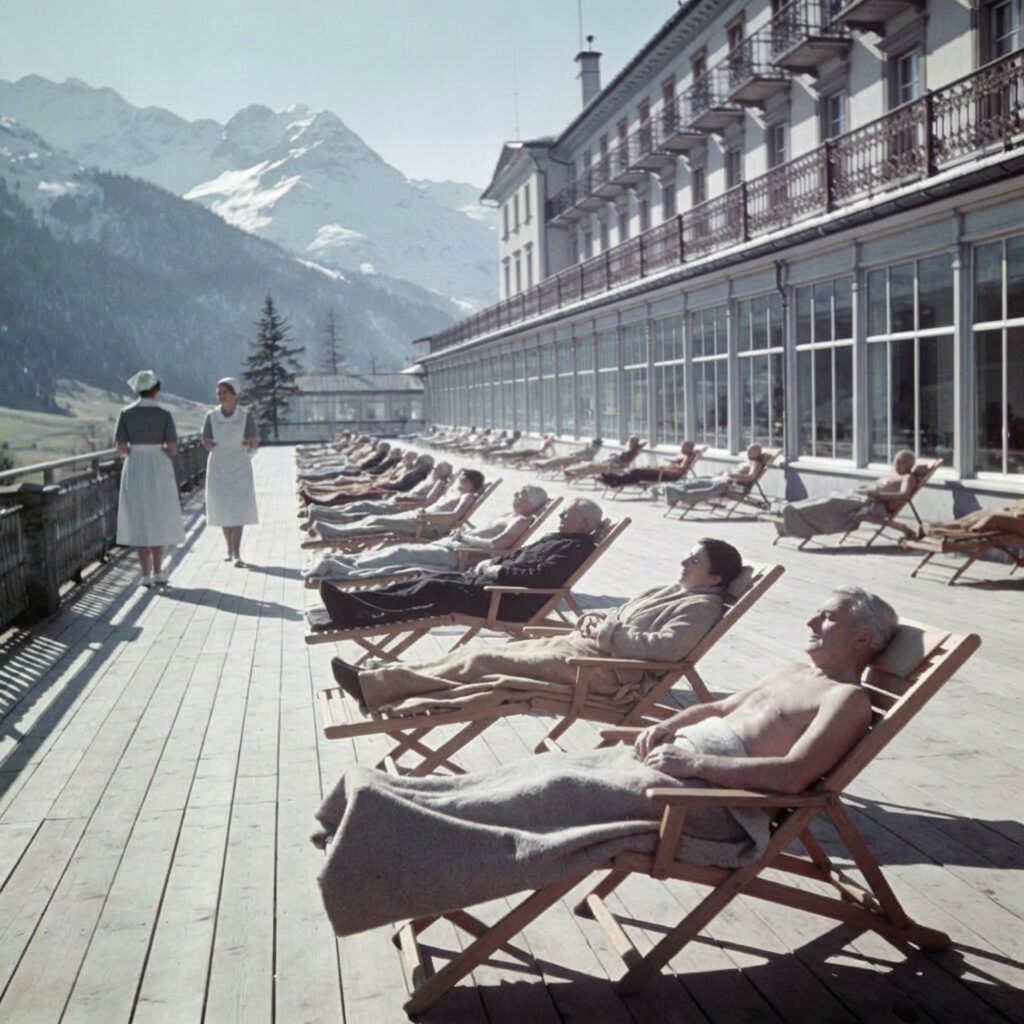
One of the most characteristic elements of treatment was the so-called open-air cure. Patients spent many hours each day on specially designed terraces or galleries open to the surrounding landscape.
Lying on wooden reclining chairs, they rested outdoors, exposed to sunlight and the mountain climate. These sessions often lasted several hours a day, and even in winter, patients remained outside, wrapped in blankets despite the cold.
Architecture of Light
Sanatoria were designed to maximize access to daylight. Buildings featured wide galleries, glass-enclosed winter gardens, and large windows. Architecture was not merely a backdrop to treatment, it was part of the therapy itself.
One example of this approach was the sanatorium building of Dr. Römpler in Görbersdorf, known today as the “White Eagle,” whose glass roofs and treatment galleries enhanced access to natural light.
Treatment Through Environmental Stimuli
In addition to light, other elements were used to strengthen the body. Patients engaged in regular walks along mountain paths, and hydrotherapy was also applied, hardening the body through exposure to cold water.
For Brehmer, sunlight was part of a broader system in which the organism could regain balance through interaction with its environment.
Davos: The Capital of Light and Air Therapy
The idea of climate-based treatment quickly spread across Europe. In the following decades, similar sanatoria began to appear throughout the Alps, particularly in Switzerland. One of the most renowned centers became Davos.
By the late 19th century, the town was attracting patients from across Europe, and later also from the United States. Sanatoria in Davos were designed to maximize exposure to sunlight, with long balconies, open terraces, and large south-facing windows.
Patients spent many hours each day outdoors, resting on balconies and reclining chairs. It was in places like these that one of the most iconic images of the era was born: rows of patients lying on balconies in the middle of winter, their faces turned toward the sun.
[AI-generated image]
Auguste Rollier and the Development of Heliotherapy
In the early 20th century, Swiss physician Auguste Rollier took the method of sunlight-based treatment even further.
At his clinic in Leysin, he developed a system of gradual, full-body exposure to sunlight, particularly in the treatment of bone and joint tuberculosis. Patients were first exposed to light for short periods, with the duration of exposure gradually increased over time.
Rollier documented thousands of cases showing improvements in his patients’ health and published numerous works describing the outcomes of his treatments.
Heliotherapy became one of the most widely recognized methods of treating tuberculosis before the era of antibiotics.
Sanatoria Beyond Europe
The idea of climate-based treatment quickly spread to the United States as well.
One of the most well-known examples was the Trudeau Sanatorium in Saranac Lake, New York, founded by physician Edward Livingston Trudeau in the 1880s.
As in Europe, patients spent many hours outdoors, resting on balconies and terraces.
Sanatoria were also established in regions with dry climates and abundant sunshine, such as Colorado and Arizona.
Before the Era of Antibiotics
For several decades, sanatoria were one of the primary methods of treating tuberculosis. It was only in the 1940s, with the discovery of antibiotics such as streptomycin, that their importance began to decline.
However, the experiences of physicians working in these institutions left a lasting impact on medicine.
They demonstrated that the environment, light, air, space, and daily rhythm can play a significant role in the process of healing.
A Bridge to Modern Phototherapy
Sanatoria represented a transitional stage between early intuition and modern science.
Physicians could see that light helped patients, even if they did not yet fully understand why.
At the beginning of the 20th century, however, someone would attempt to bring light out of the mountain landscape and into the laboratory. His name was Niels Finsen.
He would become the first to concentrate light into a therapeutic lamp and demonstrate that radiation could be used as a precise medical tool in clinical settings.
With this, the history of light in medicine entered a new chapter.
Sources:
- “The White Death: A History of Tuberculosis” Thomas Dormandy, 1999.
- “Sunlight therapy and solar architecture”. Hobday RA., Medical History. 1997;41(4):455-472.
- “The Greatest Benefit to Mankind: A Medical History of Humanity” Roy Porter, 1997.
- “The history of sanatoriums and surveillance”, WelcomeCollection