For thousands of years, sunlight has been one of the key environmental factors shaping biological rhythms and everyday functioning. In recent decades, however, the narrative around ultraviolet (UV) exposure has been largely dominated by risk, particularly in relation to skin cancer.

While the risks associated with excessive exposure are real and well documented, a growing body of research shows that the way we use light plays a crucial role in how it affects the body.

On the occasion of World Cancer Day (February 4), it is worth approaching sun exposure in a balanced way, recognising the risks of excessive exposure, while also highlighting the importance of moderate and conscious interaction with light in adults, alongside the need for strict protection of children from sunburn.

Skin Cancer – A Real Risk with Excessive UV Exposure

Ultraviolet (UV) radiation is a well-established risk factor for skin cancer. Three main types are distinguished:

  1. Basal cell carcinoma (BCC): the most common type, slow-growing, rarely metastasises, but can cause extensive local tissue damage.
  2. Squamous cell carcinoma (SCC): more aggressive, capable of local invasion and metastasis, particularly after long-term UV damage.
  3. Melanoma: the most dangerous form of skin cancer, rapidly progressing and associated with high mortality in advanced stages.

The risk of developing skin cancer is higher in individuals with fair skin (check your skin phototype here), a high number of moles, and in those who have experienced intense sunburns, especially at a young age. Importantly, the consequences of such exposure may not become apparent until years later, which often leads to underestimating the risk.

Exposure Pattern Matters

Not all sun exposure carries the same biological risk. Research clearly distinguishes between:

  • short, regular, adaptive exposure, and
  • intense exposure leading to sunburn.

It is sunburns, rather than balanced sun exposure, that are most strongly associated with an increased risk of melanoma.

The skin does possess natural adaptive mechanisms, such as melanin production and thickening of the epidermis, but these processes require time and gradual exposure.

What Do the Latest Population Studies Say About Sun Exposure?

Recent large-scale analyses, including data from the UK Biobank, indicate that the relationship between UV exposure and health outcomes is complex and not limited to the skin. These observations do not justify increasing UV exposure and do not change the importance of preventing sunburn.

Protect children’s skin from sunburn

Why Is Children’s Skin Particularly Vulnerable to UV Exposure?

Children need daylight for healthy development and proper regulation of circadian rhythms, but a child’s skin is not simply a smaller version of adult skin. It differs both structurally and functionally, making it significantly more sensitive to ultraviolet (UV) radiation.

Children’s skin:

  • is thinner, allowing UV radiation to penetrate more deeply,
  • contains less melanin, the natural pigment that protects against UV radiation,
  • has an immature protective barrier and less efficient DNA repair mechanisms.

As highlighted by the authors of a review published in the Journal of the American Academy of Dermatology, these characteristics mean that the same dose of UV radiation causes greater and more long-lasting biological damage in children than in adults, even if the immediate effects appear mild and are limited to temporary skin redness.

This is why sunburns during childhood are among the best-documented risk factors for melanoma later in life.

Indoor Tanning: For Adults Only, with Moderation and Awareness

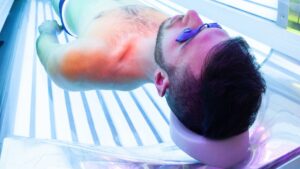
Indoor tanning is a source of ultraviolet (UV) radiation (UVA and UVB), similar to natural sunlight. From a biological perspective, it is the dose, intensity, and pattern of exposure that matter – not the origin of the radiation itself.

Modern tanning devices are designed to reflect the spectrum of natural sunlight, allowing for controlled and repeatable exposure, independent of season or weather conditions.

What is important to know?

  • Indoor tanning delivers a concentrated dose of UV in a short period of time,
  • uncontrolled or overly frequent use may increase the risk of photodamage to the skin,
  • it allows for predictable exposure, but its effects depend on frequency, dose, and individual factors.
solarium tylko dla dorosłych, tanning beds not for children, above 18, powyżej 18 lat

Indoor Tanning: The European Safety Standard – 0.3

In the European Union, the EN 60335-2-27 standard applies, limiting the maximum effective UV irradiance of tanning devices to 0.3 W/m². This level is comparable to natural midday sunlight in Southern Europe and serves as a technical reference point for the safe operation of tanning equipment.

This standard does not eliminate risk associated with excessive use, but it defines conditions under which UV exposure can be controlled and remain predictable.

Indoor tanning, like sunlight, is a source of UV radiation, and its effects depend on how it is used. It requires knowledge, moderation, and responsibility.

An Important Boundary: Children and Adolescents

The use of tanning devices is prohibited for individuals under the age of 18.

Adults: Conscious Balance, Children: Absolute Protection

Balanced sun exposure applies to adults who are able to observe their skin’s reactions and adjust exposure time according to skin phototype, time of day, and UV index.

When it comes to children, there is no room for compromise:

  • protecting a child’s skin is an adult responsibility, not a matter of personal choice,
  • no one should experience sunburn, and adults in particular must never allow sunburn to occur in children.

Sunlight as an Environmental Factor

Sunlight is neither an enemy nor a universal remedy. It is a powerful biological stimulus that can affect the body in different ways. Therefore, in the context of skin cancer prevention, the following remain essential:

  • moderate, regular exposure in adults,
  • zero tolerance for sunburn,
  • special protection of children’s skin.

Education and informed decision-making by adults are among the most effective strategies for preventing skin cancer today.

Resources:

Explore More